How I Beat My Nagging Urge to Pee in 1 Week and Started Living Again
If you have an overactive bladder or occasional leaking, you'll want to read this…

For years I hated going out.
Big events were the WORST.
The bathrooms were always too few and too far away.
I'd get the urge to pee and start searching for a ladies' room.
Then when I'd finally find one, there'd always be a line of women out the door.
Waiting in those lines left me with little to do but silently pray that I could hold it long enough without having an accident.
You see, even though I would ALWAYS go before I left the house (whether I needed to or not)…
and watch every drop I drank from that moment forward… I'd still feel like I had to pee.
Which meant going out, seeing friends, traveling, or even joining my family at the park for a barbeque, would fill me with anxiety.
Instead of being excited to spend time with my loved ones, I'd be in a panic thinking:
"Where would I go when I needed to pee?" And "How fast can I get there?"

Because needing to pee was always on my mind.
The Doctors Had No Real Answers
Over the years I saw a lot of doctors looking for help.
Some would tell me to cut out coffee, cut out alcohol, cut out sugar, cut out salt, cut out pretty much everything.
And I did what they told me, but it didn't help.
Other doctors would give me a bunch of exercises to do, tell me to check back in 6 months, and send me on my way. Then, when I came back and told them the exercises didn't help, they'd say "Well, it's just a normal part of aging" and that I should just plan accordingly.
Which I knew meant wearing diapers.
But I refused to give up.
Over and over, doctor after doctor gave me another "solution" to waste my time and money on.
After spending years pinballing around town to different specialists, I finally decided to
take my health into my own hands.
I started reading every book, article, and research study I could find on the problem. And soon I discovered…
Three Little-Known Facts About Overactive Bladder
First, it turns out that urgency is super common. According to Yale Medicine, up to 40% of ALL U.S. women have an overactive bladder.
That means that at any given time nearly half of the women around me might also be fighting the urge to pee.
No wonder there are always long lines out of the ladies' room!
It also meant that all that time I'd felt isolated and alone, trying to hide my peeing problems, I should've been talking to my friends and family.
What really surprised me though, is that it's nearly as common in men — Yale Medicine also says up to 30% of men suffer with overactive bladder too.
But as common as it is, according to the American Urological Association, it's actually NOT a normal part of getting older. So now I knew it wasn't about my age, and more importantly, I finally had hope that I could find a way to stop peeing all the time.
Second, I discovered that peeing frequently, sudden urges to pee, occasional urine leakage, and waking up to pee at night could all be caused by the same underlying issue.
Third, I learned that the surprising hidden culprit behind all of my symptoms was something my doctors had completely ignored.
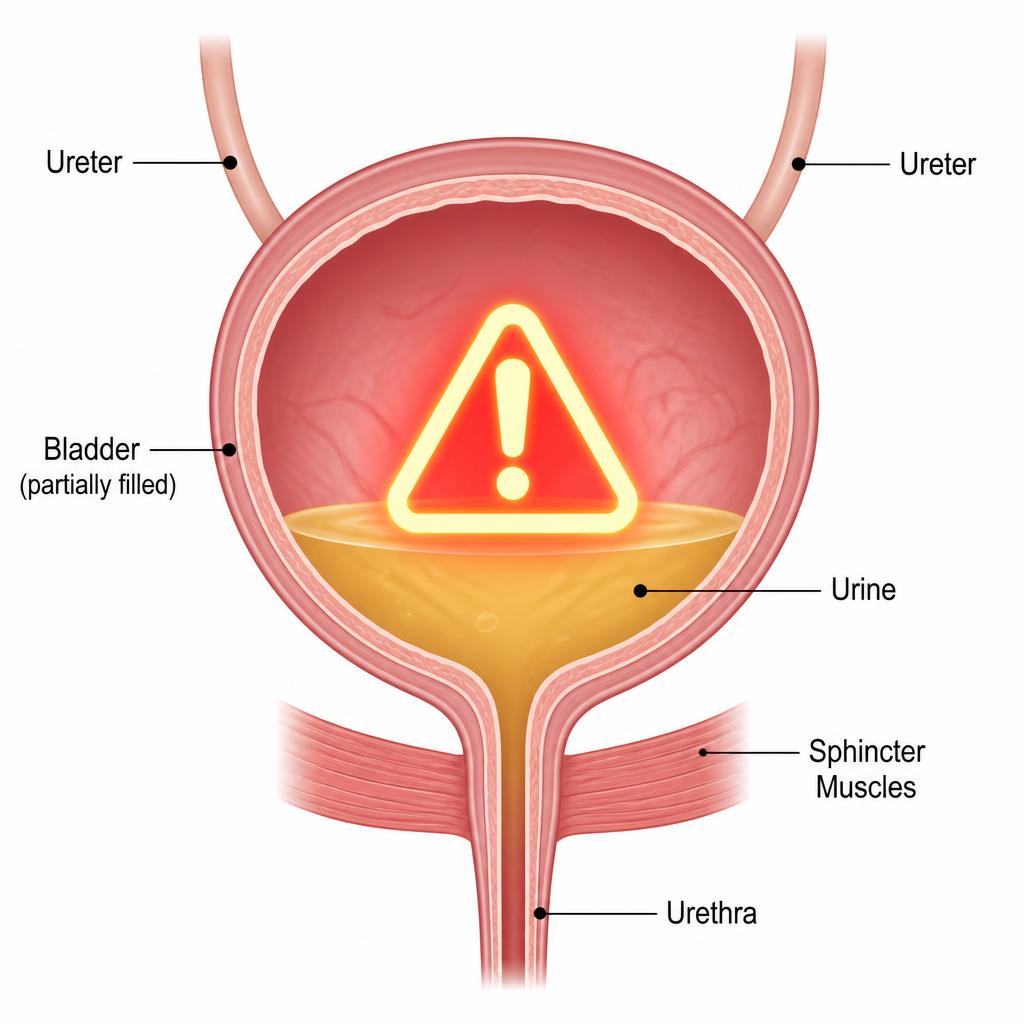
The real problem isn't your bladder. It's the signals your brain keeps sending it.
At first, I balked. My bladder was the problem. Why would my brain have anything to do with it?
But the more research I read, the more it made sense. Your bladder can hold far more than your brain gives it credit for. The "urge to go" is actually a nerve signal, and in people with overactive bladder, that signal fires too early, too often, and too intensely.
According to research from the National Institutes of Health, the pelvic floor muscles and the bladder work together as a system. When they're chronically tense or poorly coordinated, the brain interprets that tension as urgency — even when your bladder is barely half full.
That means all that time I spent bracing, clenching, and rushing to the bathroom… I was training my bladder to panic. And it was getting very good at it.
But when I came across research on bladder retraining and pelvic floor relaxation, something clicked. Scientists found that the urge to urinate can be significantly reduced by teaching the nervous system to stand down. Not by strengthening muscles, but by releasing them. The key was calming the signal at the source, before the urgency could spiral.
And I already knew that urgency and leaking were nerve-and-muscle problems. So the answer wasn't cutting fluids or doing more kegels. I needed to retrain my bladder from the inside out.
Once I knew what I was looking for, I started searching. That's when a friend told me about a program called The Urge Button.
I was skeptical.
I'd tried exercises before. I'd tried going "just in case." I'd tried drinking less before leaving the house. Nothing really helped.
But The Urge Button felt different.
Instead of giving me another list of exercises, it gave me something to do in the exact moment the urge hit.
So the next time I felt that sudden pressure, I opened it and pressed the button.
A calm voice guided me through slow breathing, simple relaxation cues, and a few steps to help me ride out the urge instead of rushing straight to the bathroom.
And for the first time, I didn't panic.
The urge was still there, but it didn't feel like an emergency anymore.
My breathing slowed. My body relaxed. My mind stopped racing.
That was the moment it clicked:
"Wait… I can actually do this."
I didn't need to fight my bladder. I needed to retrain the way my body responded to urgency.
So I kept using it.
Every time the urge hit, I pressed the button, followed the routine, and practiced waiting a little longer.
Within days, I started noticing small wins.
I wasn't running to the bathroom as often. I wasn't peeing "just in case" every time I left the house. I wasn't constantly scanning for the nearest restroom.
For the first time in years, I felt like I had a plan.
And that gave me something I hadn't felt in a long time:
Confidence.
The Urge Button didn't make me feel broken.
It made me feel like my body could learn again.
In fact, from that first week on…

All my going going going was GONE GONE GONE.
Since then, I've been a new woman. I am so grateful and I'm blown away by the results. I'm comfortable, confident, and happy because I can go where I want, whenever I want, without worrying I'll be too far from a bathroom.
I truly can't believe that something so simple could be so life-changing. But I'm not alone. So many other men and women are seeing similar results…
"I normally go to the bathroom at least 3–4 times a night, but after just one night of doing the exercises, I didn't wake up ONCE. My urgency is just gone. Needless to say, I am VERY impressed!"
— James M.
"I did a lot of research before trying this. Within a few weeks I could feel the difference. I feel clear-headed and in control in a way I haven't in years."
— Rocio B.
"Helps Urgency! This appears to have lessened the urge to urinate a lot, allowing me to sleep longer before waking up to pee."
— Gregory B.
Customer results have not been independently verified. Results may vary.
Why Does The Urge Button Work So Well For Bladder Problems?
The secret is in the approach. Most bladder programs try to strengthen. This one teaches your bladder system to relax and respond normally again.
Bladder-brain signaling. The urge to pee starts in the nervous system. The guided techniques teach your brain to stop sending false alarms, so urgency fades before it can spiral.
Pelvic floor tension. Chronically tight pelvic muscles are one of the biggest drivers of urgency and leaking. The program walks you through targeted release techniques most people have never been shown.
Breathing & nervous system calm. Shallow, tense breathing keeps your entire system in fight-or-flight mode — including your bladder. The program resets this pattern in minutes a day.
Muscle coordination. It's not just about strength. Your bladder muscles and pelvic floor have to work in sync. The exercises retrain that coordination from the ground up.
Why The Urge Button Leaves Other Options Behind
Kegel exercises? They miss the point. Kegels focus on squeezing, but urgency is usually caused by muscles that are too tight, not too weak. Squeezing a tense muscle tighter makes the problem worse. The Urge Button starts with release before strengthening, which is why it works when kegels haven't.
Cutting fluids? That backfires. Drinking less concentrates urine, which irritates the bladder lining and makes urgency worse. It also trains your bladder to expect less, shrinking its functional capacity over time. The Urge Button addresses the actual cause so you don't have to ration water for the rest of your life.
Medication? It treats symptoms, not the system. Bladder medications can reduce urgency short-term but don't retrain anything. The moment you stop, the problem comes back. The Urge Button retrains the underlying patterns so the results stick.
Electrolytes & hydration powders? Doctors may have told you that you're dehydrated and needed more minerals. But loading up on hydration powders will only make you have to pee more often. More fluids in means more urgency out.
The bottom line: while other approaches manage symptoms, The Urge Button addresses the system that's causing them.
What Are Other People Saying?
"I have to say I think it works. I was skeptical but the results have been real."
— Rick M.
"I am over 85 and feel more in control than I have in years. I will be ordering more."
— Sjaan W.
"My husband and I both do the program every day. We both feel better."
— Mary B.